


When a furnace stops working, homeowners often focus on the final price without knowing what actually contributes to the bill. A furnace repair invoice can include diagnostic services, technician labor, replacement parts, equipment access, and additional charges for emergency or specialized work. Understanding these components can make it easier to evaluate an estimate and decide how to proceed.
Current 2026 cost guides show that furnace repair pricing varies considerably depending on the failed component, furnace type, location, accessibility, and labor requirements. National data places many routine repairs in the low hundreds of dollars, while Orange County-specific estimates show that more complicated repairs can reach well above $1,000.
What Makes Up a Furnace Repair Bill?
A typical repair bill can be divided into three primary categories: service or diagnostic charges, labor, and parts.
The diagnostic portion covers the technician’s time spent identifying the actual problem. Labor covers the work required to access, remove, install, test, and verify components. Parts represent the physical components required to restore the furnace.
Some contractors use flat-rate pricing, while others may charge time and materials. Asking how an estimate is structured before approving the work can help prevent confusion later.
Understanding Furnace Diagnostic and Service Costs
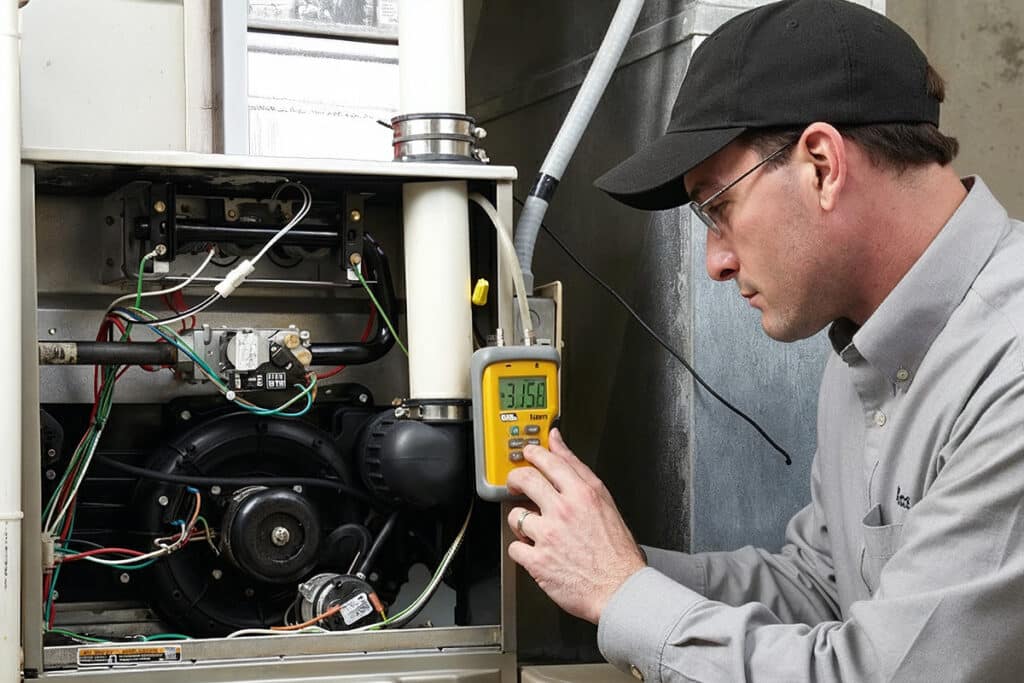
Before a technician replaces a component, the furnace should be properly inspected. A diagnostic appointment may involve checking electrical connections, thermostat signals, safety switches, ignition components, airflow, gas pressure, and other operating conditions.
Published Orange County pricing examples for 2026 put diagnostic or service visits roughly around $50 to $169, although actual charges vary by company and circumstances. Some companies apply the diagnostic fee toward the repair if the homeowner approves the work.
A diagnostic charge is not necessarily an indication that the repair will be expensive. It pays for the troubleshooting process needed to identify the underlying failure rather than simply replacing parts based on symptoms.
How Labor Affects Furnace Repair Costs
Labor can represent a substantial portion of a furnace repair because heating systems require specialized knowledge and safety testing.
A 2026 national cost guide places professional furnace repair labor around $50 to $150 per hour, while Orange County-specific pricing information lists HVAC repair labor at approximately $135 to $195 per hour. Many residential HVAC companies, however, use flat-rate pricing instead of charging customers strictly by the hour.
The complexity of the repair matters. Replacing an easily accessible sensor may require considerably less work than removing a blower motor or accessing a difficult-to-reach component.
Labor can also increase when a furnace is installed in a cramped closet, attic, crawlspace, or another difficult location. Older systems may require additional troubleshooting because wiring, connections, or components can be difficult to access.
Common Furnace Parts and Their Costs
Different furnace components have very different replacement costs. Current 2026 estimates provide useful general ranges, but homeowners should treat them as market guidance rather than guaranteed prices.
Igniters
Igniters are relatively small components, but a failed igniter can prevent a furnace from starting. Orange County estimates commonly place igniter replacement around $150 to $400, depending on the equipment and contractor.
The final price includes more than the component itself because the technician must diagnose the ignition problem, install the replacement, and verify safe operation.
Flame Sensors
A dirty or failing flame sensor can cause a furnace to ignite briefly and then shut down. Replacement estimates in Orange County commonly fall around $150 to $350, although simple cleaning may cost less when the sensor itself remains functional.
Blower Motors
The blower motor moves heated air through the home’s ductwork. Because it is a larger mechanical component and can require more labor to access and replace, its repair cost can be substantially higher.
Published estimates range from several hundred dollars to considerably more for certain variable-speed or specialized motors.
Gas Valves
Gas valves control the flow of fuel to the furnace burners. Because gas-related repairs involve important safety considerations, diagnosis and post-repair testing are particularly important.
Orange County estimates commonly place gas valve replacement in the several-hundred-dollar range, with published figures varying from approximately $350 to $900.
Control Boards
The control board coordinates many furnace functions. A defective board can be expensive to replace, but a technician should verify that the board is actually the source of the problem before installing a new one.
Current estimates commonly place control-board replacement around $200 to $900, depending on the furnace and component.
Heat Exchangers
Heat exchanger problems deserve special attention because the component is central to the safe operation of a gas furnace. Replacement can involve substantial labor and equipment-specific parts.
Orange County estimates place heat exchanger replacement in the roughly $1,200 to $3,500 range in some cases. Because this can represent a significant percentage of the cost of a newer heating system, homeowners may want to compare repair and replacement estimates before making a decision.
Why Furnace Age Can Change the Price
The age of a furnace can affect both repair complexity and parts availability.
Newer furnaces generally have readily available replacement components. Older equipment may require discontinued or manufacturer-specific parts, which can increase sourcing time and costs.
An older furnace may also have multiple aging components. Replacing one failed part does not necessarily mean another component will fail soon, but a technician can identify other significant wear during a proper inspection.
Furnace Type and Efficiency Matter
Not every furnace has the same design. Standard systems can have simpler components than high-efficiency, two-stage, or variable-speed systems.
High-efficiency furnaces may include additional components such as specialized blowers, pressure switches, condensate systems, and secondary heat exchangers. These features can affect both parts and labor costs.
The difference is one reason homeowners should provide the technician with the furnace’s exact make and model when requesting an estimate.
Why Access Can Increase Labor Costs
A furnace that is easily accessible in a garage or utility area can be relatively straightforward to service. A unit located inside a tight closet, attic, or difficult crawlspace may require additional time.
Technicians may need to remove panels, reposition equipment, protect surrounding areas, or work within restricted spaces. These conditions can increase the labor involved even when the replacement part itself is inexpensive.
Emergency Furnace Repair Can Cost More
Timing can also affect the final price. Evening, weekend, holiday, or emergency calls may carry additional service charges.
One Orange County 2026 cost guide estimates that emergency service can add approximately $50 to $150, while national data indicates that emergency hourly rates can be significantly higher than standard labor.
When possible, scheduling routine service during normal business hours may reduce additional charges. However, safety-related furnace problems should not be ignored simply to avoid an emergency fee.
What Should Be Included in a Repair Estimate?
Before approving a significant repair, ask for an estimate that clearly explains the work.
A useful estimate should identify:
- The diagnosed problem
- The replacement part
- Labor or flat-rate repair charges
- Diagnostic or service fees
- Any emergency or additional charges
- Parts and labor warranty information
- Whether additional repairs were recommended
- The expected total price
This information makes it easier to understand exactly what you are paying for.
Why the Cheapest Estimate Is Not Always Comparable
Two estimates can have very different prices while appearing to cover the same repair. One contractor might include diagnosis, installation, testing, warranty coverage, and cleanup, while another may list only the replacement component.
For this reason, homeowners should compare the scope of work, not just the final number.
The type and quality of replacement part can also matter. Some furnaces require manufacturer-specific components, while others can use approved compatible parts.
Questions to Ask Before Approving Furnace Repairs
If you receive a repair estimate, consider asking:
- What exactly caused the furnace to fail?
- Which component needs replacement?
- Was the component tested before recommending replacement?
- Is the quoted price for parts and labor combined?
- Is the diagnostic fee included or separate?
- Is the replacement part manufacturer-specific?
- How long should the repair take?
- What warranty applies to the part?
- What warranty applies to the labor?
- Are there any other safety concerns that should be addressed?
Clear answers can help you understand the repair rather than simply accepting an unexplained price.
Repair or Replacement: What Should Homeowners Consider?
A high repair estimate does not automatically mean a furnace needs replacement. The decision depends on several factors, including the furnace’s age, repair history, efficiency, condition, availability of parts, and the cost of a replacement system.
For example, spending a few hundred dollars on a relatively straightforward repair may be reasonable for an otherwise well-maintained furnace. A major repair on an older system may require a more detailed comparison.
Current Orange County replacement estimates vary significantly by equipment and installation requirements, with published 2026 figures ranging from several thousand dollars to considerably more for complex installations.
How to Keep Furnace Repair Costs Manageable
Regular maintenance can help identify worn components before they cause an unexpected breakdown. Replacing filters as recommended, keeping supply and return vents unobstructed, and arranging professional inspections can support reliable operation.
Homeowners should also avoid attempting gas-related or complex electrical repairs without appropriate qualifications. Improper furnace repairs can create safety risks and may cause additional equipment damage.
When homeowners need furnace repair Orange County, understanding the relationship between labor, parts, diagnostics, and service charges makes the estimate easier to evaluate. A clear written quote and accurate diagnosis are important regardless of the final repair price.
Final Thoughts
Furnace repair costs are not determined by one universal price. A small sensor or igniter problem may cost a few hundred dollars, while motors, control boards, gas valves, or heat exchangers can result in significantly higher bills. Labor, equipment accessibility, furnace age, parts availability, and emergency timing can all affect the final amount.
The best way to understand a repair estimate is to look beyond the total and examine what the price includes. With an accurate diagnosis, an itemized estimate, appropriate replacement parts, and clearly stated warranty terms, Orange County homeowners can make a more informed decision about maintaining or repairing their heating system.
