


Artificial intelligence is evolving at a rapid pace. Over the last few years, you have probably heard a lot about generative AI. It writes content, creates images, and even generates code. Now, another powerful concept is gaining traction in enterprise circles which is agentic AI solutions.
Many business leaders in the United States are confused about the difference between these two approaches. Are they the same? Is one better than the other? Or do they serve different purposes?
In this blog, you will clearly understand how agentic AI solutions differ from generative AI, and why this distinction matters for your organization.
Understanding Generative AI
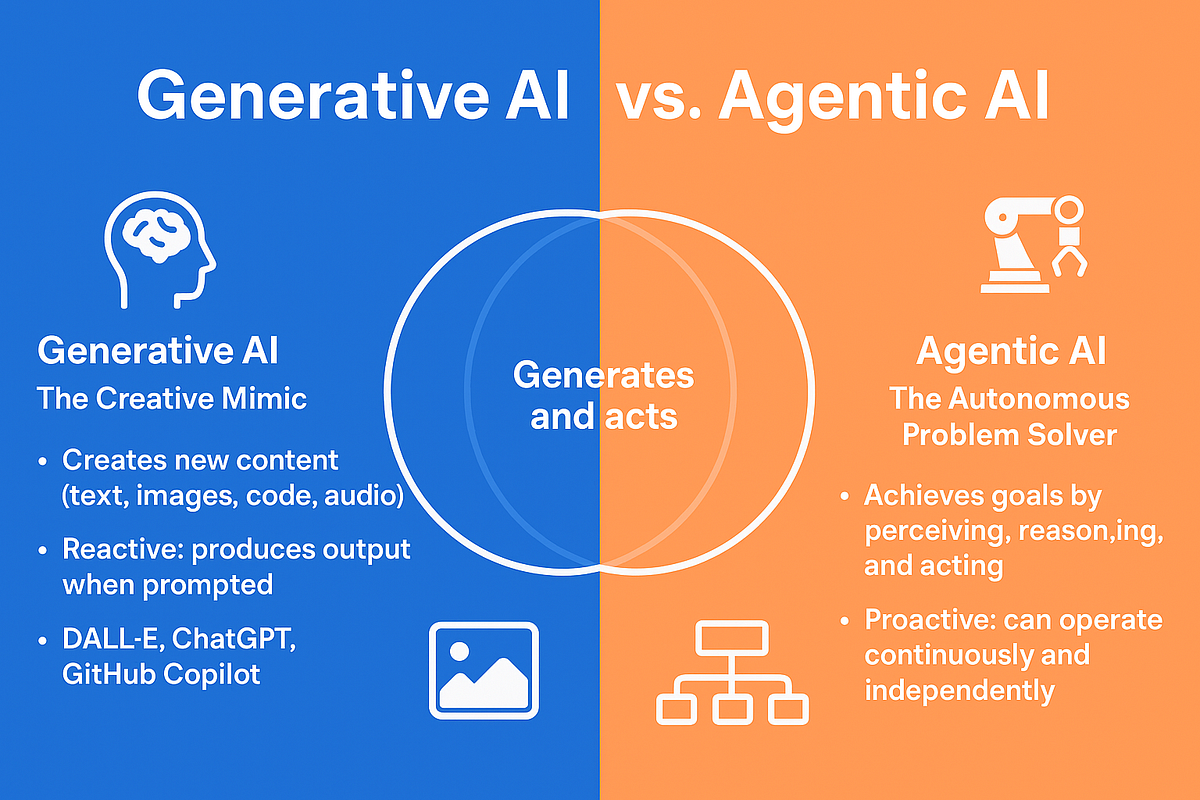
Generative AI focuses on content creation. It produces text, images, audio, or code based on prompts. When you ask it to draft a marketing email, summarize a report, or generate product descriptions, it delivers output based on patterns learned from large datasets.
Generative AI is reactive. It waits for instructions. It performs well when guided by human input. According to recent AI adoption reports, over 80 percent of US enterprises are already experimenting with generative AI tools for content production and productivity enhancement.
What Are Agentic AI Solutions
Agentic AI services & solutions go far beyond content creation. They are designed to act autonomously toward defined goals. Instead of waiting for prompts, they plan, execute, evaluate outcomes, and adjust strategies independently.
For example, generative AI might write a sales email. An agentic AI system can identify target customers, personalize the message, send it at optimal times, monitor engagement, follow up automatically, and adjust strategy based on response rates.
That proactive capability is the defining difference.
Reactive Systems vs Goal Driven Systems
Generative AI operates in a reactive mode. You provide a prompt and receive an output.
Agentic systems operate in a goal driven mode. You define an objective such as increasing customer retention by 10 percent. The AI agent determines the steps needed to reach that objective, executes actions, analyzes performance data, and refines its approach.
This shift from output generation to goal execution is what makes agentic AI solutions for enterprises particularly powerful.
Scope of Capabilities
Generative AI specializes in creation. Its primary function is producing content quickly and efficiently.
Agentic AI integrates multiple capabilities including reasoning, planning, workflow orchestration, decision making, and system integration. It can use generative models internally, but it is not limited to content creation.
Think of generative AI as a tool. Think of agentic AI as a manager coordinating multiple tools to achieve results.
Level of Autonomy
Autonomy is one of the most important distinctions. Generative AI requires human prompts and oversight for each interaction.
Agentic AI systems are designed to function with minimal supervision. They monitor environments, trigger workflows, and make decisions continuously.
In enterprise environments, this autonomy can reduce operational delays by up to 30 percent, according to industry case studies.
Integration with Enterprise Systems
Generative AI tools are often used as standalone applications or integrated into productivity software.
Agentic AI data solutions, on the other hand, connect deeply with enterprise ecosystems including CRM platforms, ERP systems, analytics dashboards, and supply chain tools.
This integration allows agentic systems to act directly within operational frameworks rather than simply producing outputs.
Impact on Business Productivity
Generative AI improves individual productivity. Employees can draft reports faster and generate ideas quickly.
Agentic AI improves organizational productivity. It coordinates tasks across departments, automates decision cycles, and reduces manual workflow dependencies.
Enterprises adopting advanced agentic AI services & solutions report efficiency improvements ranging from 25 to 45 percent in complex operational processes.
Risk and Governance Considerations
Both technologies require governance. Generative AI presents risks such as inaccurate outputs or inconsistent tone.
Agentic AI introduces additional considerations because it performs actions autonomously. Strong oversight, compliance frameworks, and monitoring systems are essential.
Organizations that establish clear governance policies are significantly more likely to achieve sustainable ROI from AI initiatives.
When to Use Generative AI
Generative AI is ideal when your primary need is content production, idea generation, summarization, or conversational support.
If your team needs faster drafting, brainstorming, or coding assistance, generative AI provides immediate value.
When to Use Agentic AI Solutions
You should consider agentic AI solutions for enterprises when your goal involves workflow automation, strategic decision making, or cross functional coordination.
If you want systems that can analyze data, determine actions, execute tasks, and refine outcomes without constant human prompts, agentic AI is the better fit.
The Future: Complementary Technologies
It is important to understand that these technologies are not competitors. They are complementary.
Agentic systems often rely on generative models for content creation within broader workflows. The difference lies in orchestration and autonomy.
As enterprises mature in their AI adoption, many will combine both approaches to maximize impact.
Conclusion
The difference between generative AI and agentic AI solutions comes down to scope and autonomy. Generative AI creates. Agentic AI executes goals. Generative systems enhance individual productivity, while agentic AI services & solutions transform enterprise workflows through intelligent automation and decision making.
If you are evaluating AI investments in your organization, understanding this distinction helps you choose the right technology for the right purpose. For enterprises seeking scalable transformation and long term competitive advantage, agentic AI data solutions represent the next strategic step beyond simple content generation.
